Beryl Jane Hughes was born in Rotorua in 1929. Due to her father’s job as a Health Inspector, her family moved around the North Island a lot, settling in Morrinsville where Beryl undertook her schooling years. She developed an interest in nursing from an early age. As she did well academically, her family and school wanted her to pursue teaching or accountancy, but Beryl had ‘already decided’ upon nursing.
Beryl only applied to Waikato Hospital for her nursing training as that was the closest to her family in Morrinsville. Her class of about thirty in 1951 consisted of a mix of ages, previous occupations, and hometowns. Beryl initially had difficulties – ‘it was dreadful, I was terribly shy’. One day she walked in on her roommate in the nurses’ home wearing her clothes, which she said was a shock! Her family was a several-hour bus-ride away and she rarely saw them during her nursing training.
Beryl’s nurse training consisted of classroom and hands-on education. Her class lectures were expected to be noted down exactly as they had been told. They also had ward work - ‘we got thrown in the deep end quite quickly!’ This was six days a week, with seven to nine hour shifts. Beryl recalls the joy of looking at the rosters and seeing you had the next day off. The nurses had to put in a special request to get two days in a row off, which Beryl needed to visit her family. They were paid three pounds and four pence a fortnight in their first year, and three pounds six and eight in their second year, with board, linen, meals and uniforms supplied. Beryl paid for her own white isle stockings and white shoes out of her salary. There were many strictly enforced rules, but no one grumbled about the conditions or pay – if you wanted to do nursing ‘you just did it’.
There was an emphasis on self-responsibility for the nurses. They nurses made their own stock of resources, including cotton balls, gauze dressings and rolled bandages; if you ran out, it was your own fault because you hadn’t made enough. The nurses also had to pass their external junior state exam before they could progress to their final exam, which consisted of both medical and bedside elements including how to make patients a lemon drink. Some trainees didn’t stay long: Beryl recalls that when girls made mistakes they were often pressured to leave. There was also the expectation that the nurses would work even if they were sick; it was hard to get time off.
The nurses became close friends. They would get together as a group, sharing birthdays or food brought back from trips away. Beryl’s class used the washhouse as place to talk, sitting on either the bench or the floor, about anything on their minds. Beryl is still in contact with some of them today. She recalls that it was hard to maintain outside relationships as there was a 10pm curfew. Some girls did have boyfriends, and some got engaged during the time they were training, but Beryl says there ‘weren’t the same sort of temptations as there were in big city’. The girls were not allowed to marry or live away from the Nurses’ Home - one girl couldn’t sit her final exam as she had got married and was pregnant.
Beryl graduated in 1952. She stayed on at Waikato Hospital for a year before going on to do maternity training in New Plymouth for another year in 1953.
In 1954, Beryl went to America where one of her sisters lived, and worked at Ann Arbor University of Michigan Hospital for eighteen months. She describes this time as being ‘a real eye-opener’.
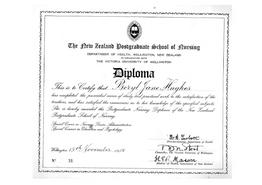
Beryl came back to New Zealand in 1956 as her other sister was getting married. She knew clearly after her training that she wanted to work in the surgical area of nursing, and so she successfully applied to work in the women’s surgical ward at Auckland Hospital. She also got her Post-graduate Diploma in Wellington 1959, and later was very involved in setting up the Unitec School of Nursing. She was awarded an honorary BA in nursing there in 2006.